Membrane Puncture Repair in Franklin, TN

One small hole near a rooftop unit is the usual first sign, and it often shows up the week after a service call. A technician sets down a tool, drags a hose across the sheet, or steps on a screw head, and the membrane is cut. The hole is the size of a pencil tip, and the damage it feeds below is far larger.
We walk a puncture backward from the hole to the cause and then forward to the wet layer. On the low-slope office and retail roofs of Franklin, TN, a small opening has plenty of rain to work with.
One small hole
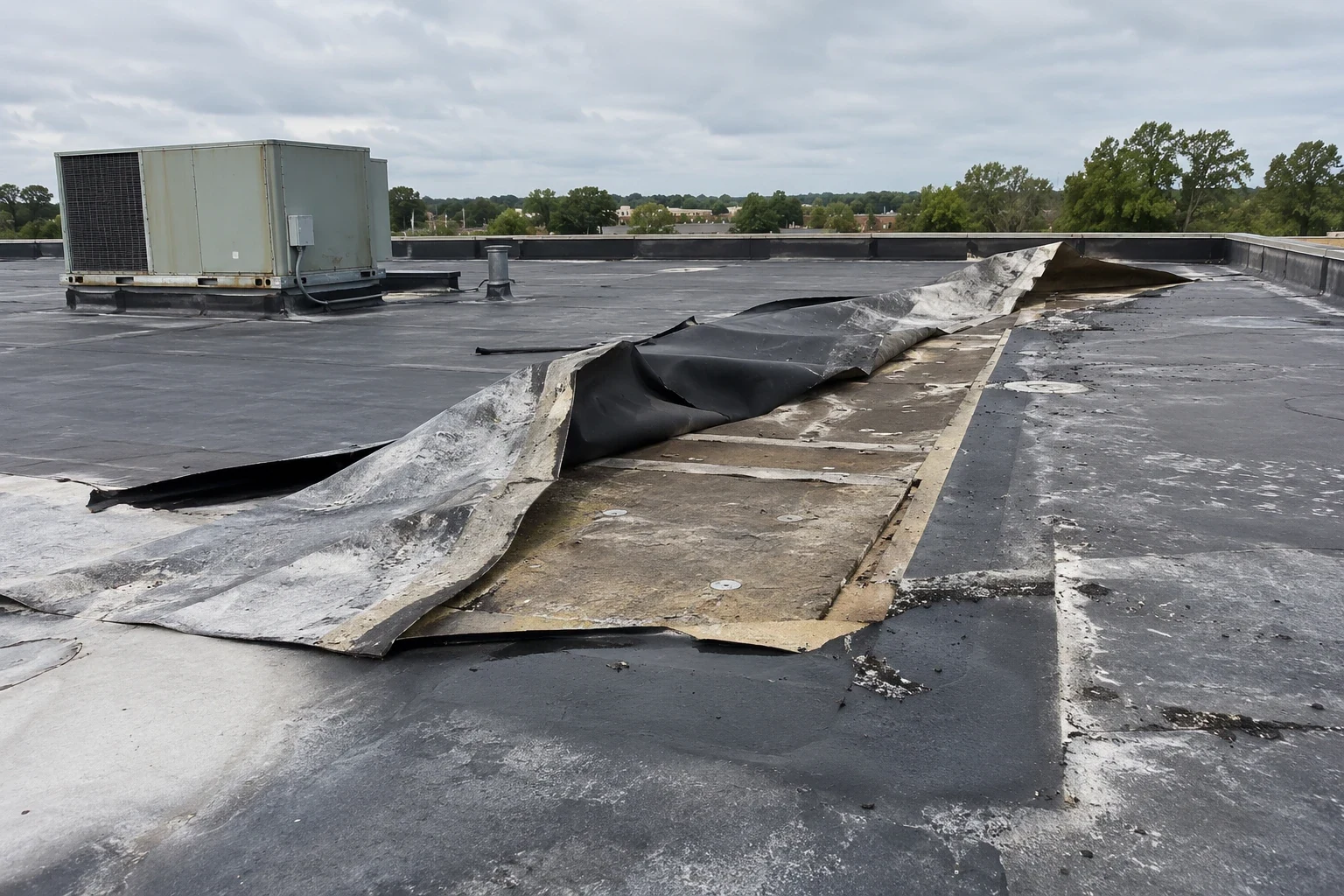
Punctures cluster in predictable places: around rooftop units, along the path from the roof hatch, at the base of walls and beside skylights. Look for small holes, scuffs that have worn through the top layer, tears with a clean edge, dents in the membrane over a fastener, and pieces of debris that landed hard.
Inside, the signs are patchy. A stain may appear after a heavy rain and dry in a day, then reappear weeks later. That pattern, intermittent and tied to rain intensity, points to a small opening and a thin path. Record the dates of each stain and compare them to the rain events and the service visits on the roof.
Also check the roof for hail bruising. A membrane can be struck without being cut, and the damage appears as a round, slightly soft spot. A bruise is not a hole, but it is where a later puncture will start, and it belongs on the same list. If a storm is the suspect, compare the roof with what a wind damage roof repair walk finds, since debris from the same storm may have done both.
How a small hole grows
A membrane is a thin waterproof skin, and its job is to keep water out of the insulation below. When the skin is cut, water runs through the opening and wets the insulation, which absorbs it like a sponge. The wet insulation spreads the moisture outward, away from the hole, along the top of the deck.
Wet insulation loses much of its insulating value and adds weight. Over time, it feeds moisture into the deck and any steel fasteners, which corrode. A tiny puncture ignored for a year can leave a wet area many times its size. That is why the repair always includes a look at what lies under the hole.
The membrane type changes what a puncture means. Thin single-ply sheets cut and tear easily, while reinforced sheets and layered bitumen resist cuts better but still dent. Under a hot July sun the surface softens, and a heavy foot or a rolling cart can press a fastener or a stone through a sheet that would have held on a cool day. That temperature link explains why many punctures appear in summer.
Where the water went
Water from a puncture stops at the first thing that holds it: the insulation board, a joint between boards, or the top of the deck. We trace it with an infrared moisture survey and by cutting a small test square at the puncture to look at the layer below. If the insulation is dry, the repair can be a simple patch. If it is wet, the wet section is cut out and replaced before the patch goes on.
On the roofs in the Cool Springs district, where office buildings run six to eleven stories and rooftop mechanical equipment is common, service visits put foot traffic on the sheet, and punctures follow. A walkway pad along the service path costs little compared with the leaks it prevents.
Do not assume a puncture sits directly above the stain. Water can run along the deck for many feet. West of the CoolSprings Galleria, around Mallory Lane and Royal Oaks Boulevard, offices and showrooms sit in warehouse-style buildings, and on a roof like that a stain can sit one bay over from the hole that caused it. Mark both on the plan and connect them with the measured path.
Find the object
Confirm the cause by looking for the object. A hole with a clean round shape suggests a fastener or a drill. A long scratch suggests a dragged tool. A cluster of small dents and cuts suggests hail or hard debris. A July 2026 weather warning for northeastern Williamson County mentioned small hail, up to about three-quarters of an inch across; hail of that size can bruise a membrane without cutting it, so we look for fractures in the surface as well as holes.
Test the area around the hole, too. A sheet that is brittle or chalked will tear again at the edge of a patch, and the patch must reach sound material in every direction.
Patch or replace
A single puncture is a repair. The patch is cut round, with rounded corners, large enough to overlap sound membrane on all sides, and welded or adhered according to the membrane type. On a thermoplastic sheet, heat-welded patches are common. On a rubber sheet, a cured patch with primer works. On modified bitumen, a torch or cold-applied patch is used. These repairs follow the same method as any commercial roof repair.
When the roof is covered in punctures, repair stops being a good use of money. A membrane that has been scored, dented and patched many times is near the end of its service life. Weigh a roof recover or replacement against the cost of continued patching, and run a seam failure repair check at the same visit, since old seams fail in the same worn roofs.
What it costs
A patch is inexpensive. The cost lies in finding every hole, drying the roof under them and protecting the area from the next one. The drivers are the number of punctures, the size of the wet area, the roof access and the membrane type. Protective walk pads, installed along the paths technicians use, add a modest cost and cut the rate of new punctures.
Ask a simple question each time a technician visits: who is on the roof, and what path do they take? A short written rule, with a photo before and after, turns a recurring repair into a rare one.
Commercial Roofing Questions
Can a small puncture really cause a big leak?
Yes. The hole is small, but the insulation below absorbs water and spreads it outward. A pinhole can wet an area many times its size before a stain ever shows inside the building, which is why the repair includes a look at the layers under the hole.
Do walk pads help?
Yes. Pads along the service path spread the load, protect the membrane from dropped tools and mark the route technicians should follow. They cost little compared with the leaks they prevent, and they are easy to inspect on each visit.
How do I find a hole I cannot see?
A moisture scan or an electronic leak survey can find openings that are too small to spot by eye. We use them when the leak is clear but the hole is not, and we confirm the result with a small water test.
Does a patch last as long as the roof?
A patch made on a clean, dry surface with a compatible material can last for years. A patch made over dirt, moisture or an incompatible sheet will not, which is why surface preparation is recorded with the repair.
Who pays if a contractor made the hole?
Lease or service terms decide that. A dated photo from before and after the service visit gives the owner the evidence to settle it, and we can supply the repair record for the file.