Manufacturing Plant Roofing in Franklin, TN
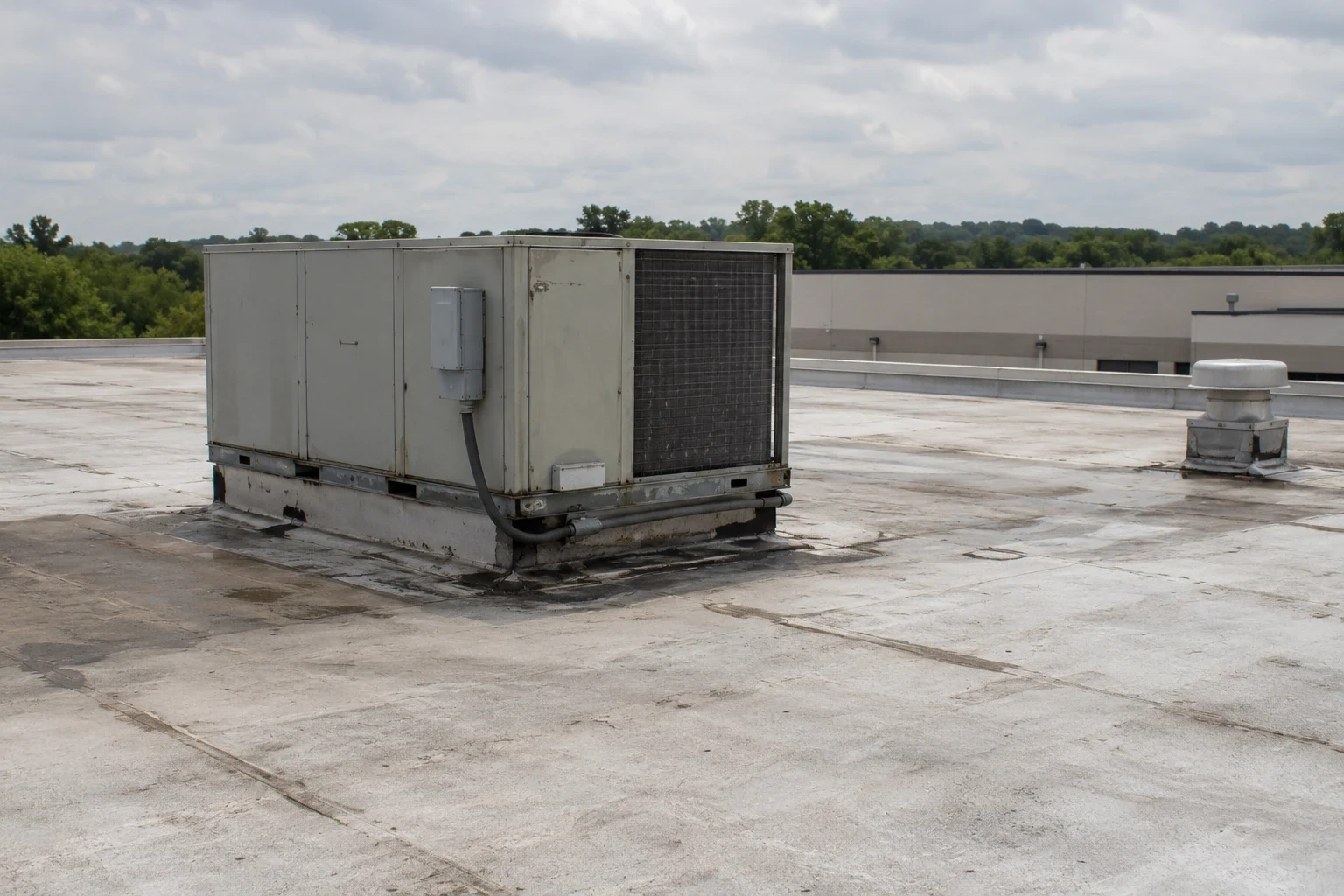
Often the first sign on a plant roof is a soft, stained band of membrane around an exhaust fan. It looks like a cosmetic mark. It is really the start of a failure sequence: heat, oil mist or chemical vapor softens the surface, the surface thins, and the next freeze or heavy rain finds the weak spot. We start with that band and walk the failure backward to the cause.
Plant roofs in Franklin, TN, low-slope and metal, are repaired, recovered and replaced by our crews around the process below. Step by step, we trace what the process does to the roof, mark the seam, flashing or drain that is giving way and send a short written summary with photos. A crew also answers emergencies at night and on holidays.
The first sign
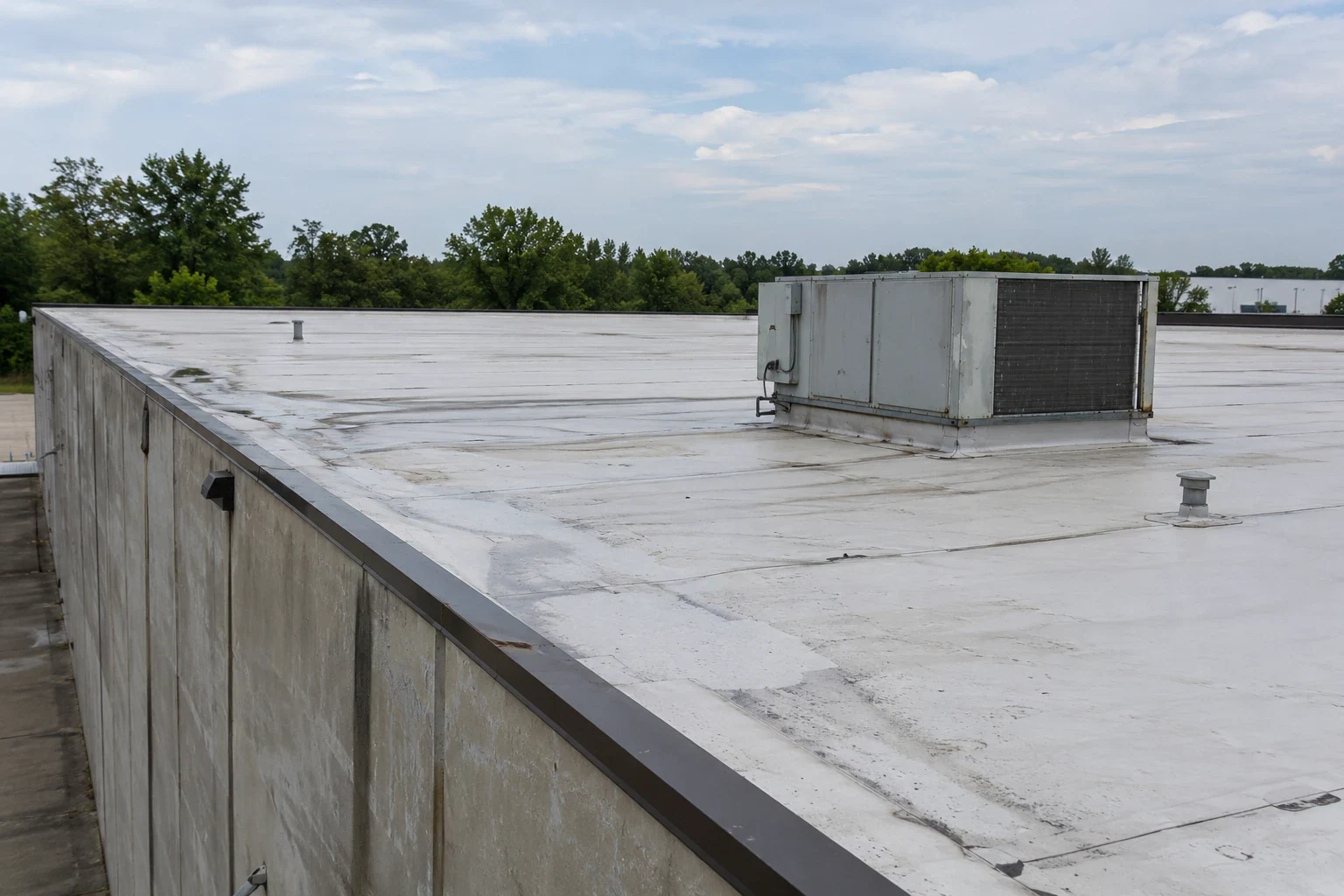
A plant roof shows trouble in layers. Near stacks and fans, the membrane stains, softens or blisters. Around equipment, the flashing cracks where heat and vibration work on it. At drains, standing water leaves a line on the membrane that says how long water sat there. Inside, stains on the ceiling over a line or a work cell tell the production manager that the roof has become part of the operation.
We photograph each sign and mark it on the roof plan. Then we compare the spots. If every stain sits near an exhaust, the cause is process exposure. If they sit along a wall, the cause is flashing. If they sit in a low area, the cause is drainage. The pattern is the lesson.
Penetration count is a second map. Stacks, hoods, conduit, gas lines and equipment supports crowd a plant roof, and each is flashed. We count them by area, rate their flashing and flag any that sit close to a drain or an edge. A roof with fifty penetrations has fifty places to fail, and the count tells the owner where the first repair dollars do the most. Abandoned stacks and capped lines that no longer serve anything are flagged for removal.
What is happening underneath
A plant roof carries a double burden. Water comes from above, and moisture and heat can come from below. Steam, washdown and process humidity rise to the deck, condense on cold surfaces in winter and wet the insulation without any hole in the membrane. The ceiling stain looks like a leak, but a patch will not cure it.
So we confirm before we repair. A moisture survey and a few cores show the wet layer, and a look at the underside of the deck shows whether condensation is the cause. If the insulation is wet from above, we repair the entry. If it is wet from below, we address ventilation or the vapor path. Cause before cure keeps the plant from paying for the same repair twice.
Cold rooms, wet processes and clean rooms below a roof change the plan. A cold room pulls moisture down into the roof assembly, and frost can build in the insulation. A clean room needs dust and odor control during any roof work. We ask what lies below every section on the first walk, mark it on the plan and write the rules into the scope. A cold storage section is handled differently from a dry assembly floor, even under the same roof.
Exhaust, chemicals and heat
Some membranes handle oils and chemical vapors better than others. PVC and KEE systems are often considered where exhaust contains grease or certain chemicals, and PVC roofing is a common choice near fans and stacks. Metal roofs have their own concerns: corrosion at fasteners and finish wear near vents.
We map each exhaust point on the plan, ask what comes out of it and check the membrane around it. The scope can then name different materials for different zones, with the reason written down. A plant manager can see why the area around a stack differs from the open field, and why the cost differs too.
Franklin weather and plant roofs
Franklin gets about 54 inches of rain a year. The mean July high is near 91 degrees, the record high is 108 and the record low is minus 22. Heat movement opens laps in summer, and freezes stiffen sealants in winter. A plant roof also carries heat from below, which adds to the swing.
Storms add wind and water. On August 12, 2023 an EF0 tornado near Highway 96 and Royal Oaks Boulevard did minor roof damage to some businesses, and the Harpeth rose to a 35.32-foot crest in downtown Franklin in the May 2010 flood. Those events are why edge metal and drainage get checked on every walk.
Where plant roofs are found
Industrial use is primary in the Southall area along Columbia Avenue south of Downs Boulevard, and the Carnton area has room for added light industrial, warehouse or office space. Nearby, the GM Spring Hill plant has been retooled for flexible vehicle assembly, and the Nissan Smyrna Assembly Plant, which began production in 1983, covers 5.2 million square feet.
Access matters. Columbia Avenue north of Mack Hatcher Boulevard has numerous curb cuts and driveways that create congestion affecting truck and crew access. We plan deliveries and lifts around it. The same staging rules apply in the Southall area and the Carnton and Lewisburg Pike area, where truck and crew routes decide where a lift can stand.
Repair or replace, and when to schedule
Commercial roof repair suits a plant roof whose insulation is dry and whose failures are isolated. If surface wear is the only issue on a sound roof, a coating may extend life. If the insulation is wet over a wide area, replace in phases. Cost depends on wet insulation volume, access, equipment to lift, penetrations and deck repair, and we write each driver down.
Plants cannot stop for a roof. We phase work around shifts and shutdown weeks, stage materials away from forklift lanes and close in each section nightly. A similar approach applies to warehouse roofs attached to the plant.
Tenants and production managers share one question: how long. We give a schedule by section, with the weather risks named. Tennessee spring storms can interrupt an open roof, so sections are sized so each day ends watertight. Material lead times are listed in the scope as well, since membranes, insulation and edge metal can take time to arrive. Daily photos show what was done and what is next.
Commercial Roofing Questions
Can process exhaust shorten the life of a roof?
Yes. Heat, oil mist and chemical vapor affect some membranes more than others. We check the roof around each stack and fan and recommend materials that suit the exposure.
How can I tell condensation from a leak?
Condensation follows humid air and cold surfaces, not rain. A moisture survey, cores and a look at the underside of the deck show which one you have, and the repair differs.
Can the plant stay in production during a roof replacement?
Usually. We work in sections, close in each section nightly and schedule noisy steps around shifts. Hot-work rules and access routes are agreed before the first day.
What does a tornado like the 2023 EF0 near Highway 96 mean for my roof?
It is regional history. Your roof is judged on its own edge metal, attachment and condition. We check those after any storm line and photograph anything that has moved.
What should a plant send before the first walk?
Share the roof age, a note of what runs below each area, the exhaust points and any leak history. On the roof we trace the failure, then write it up in a brief summary.