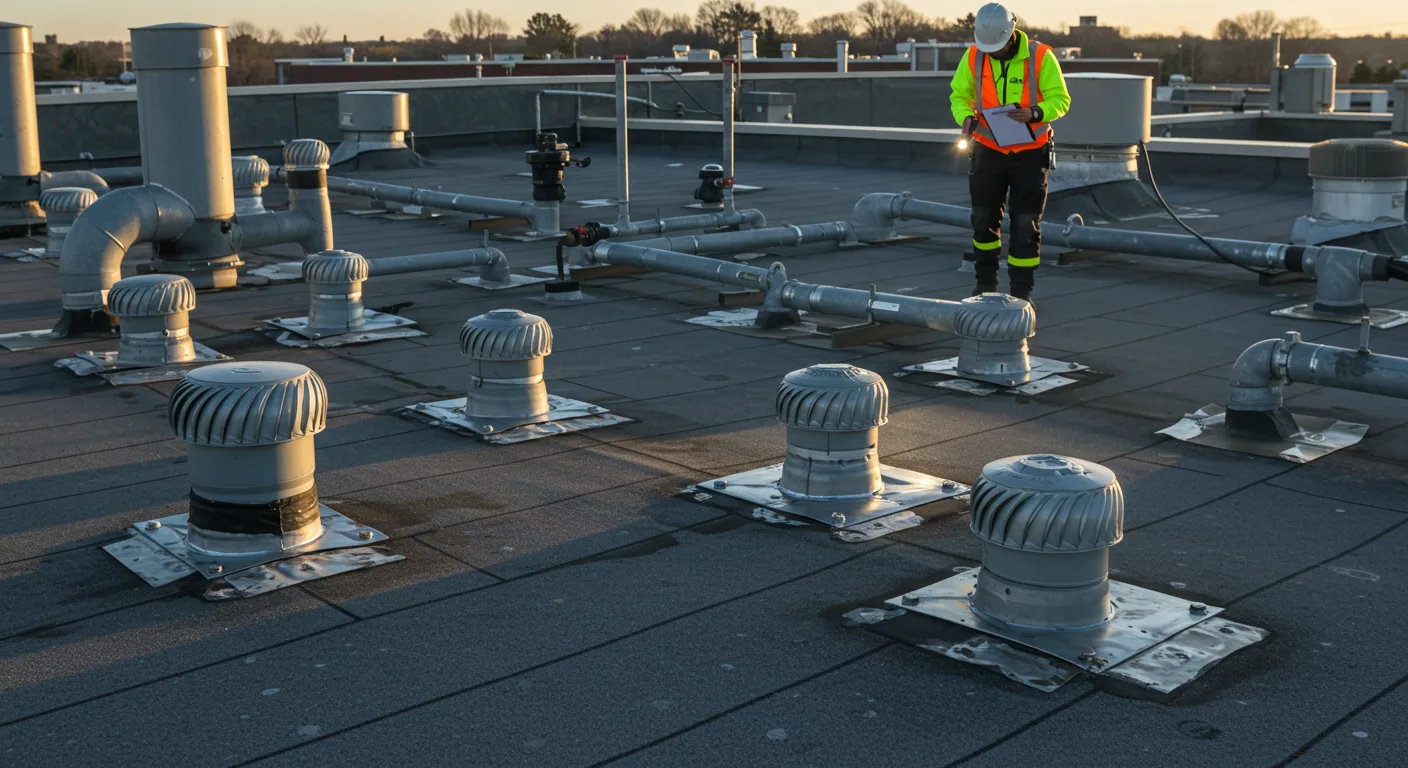
Roof Drains and Scuppers in Franklin, TN
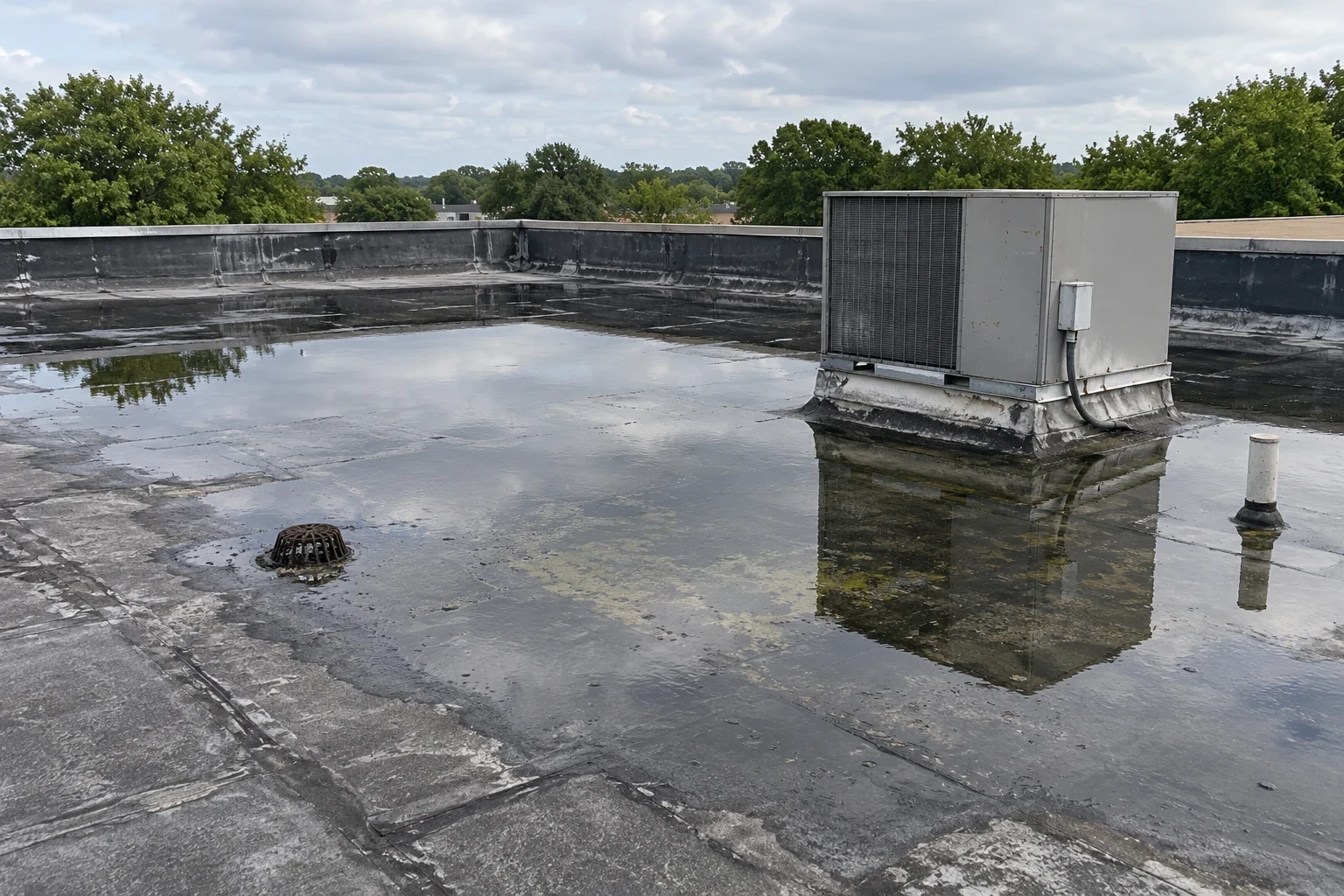
A ring of dirt and algae on the membrane, a few feet from a drain, is the first sign that a roof has been holding water. The ring is the standing-water line, and it marks how far a pond spread before it dried. Roof drains, scuppers, crickets and ponding correction all serve one job: getting water off the roof quickly. In Franklin, TN, with about 53.79 inches of rain a year, a roof that holds water ages faster than one that sheds it.
We trace each pond backward to its cause, because a clogged strainer, a sagging deck and a low-set drain need different fixes.
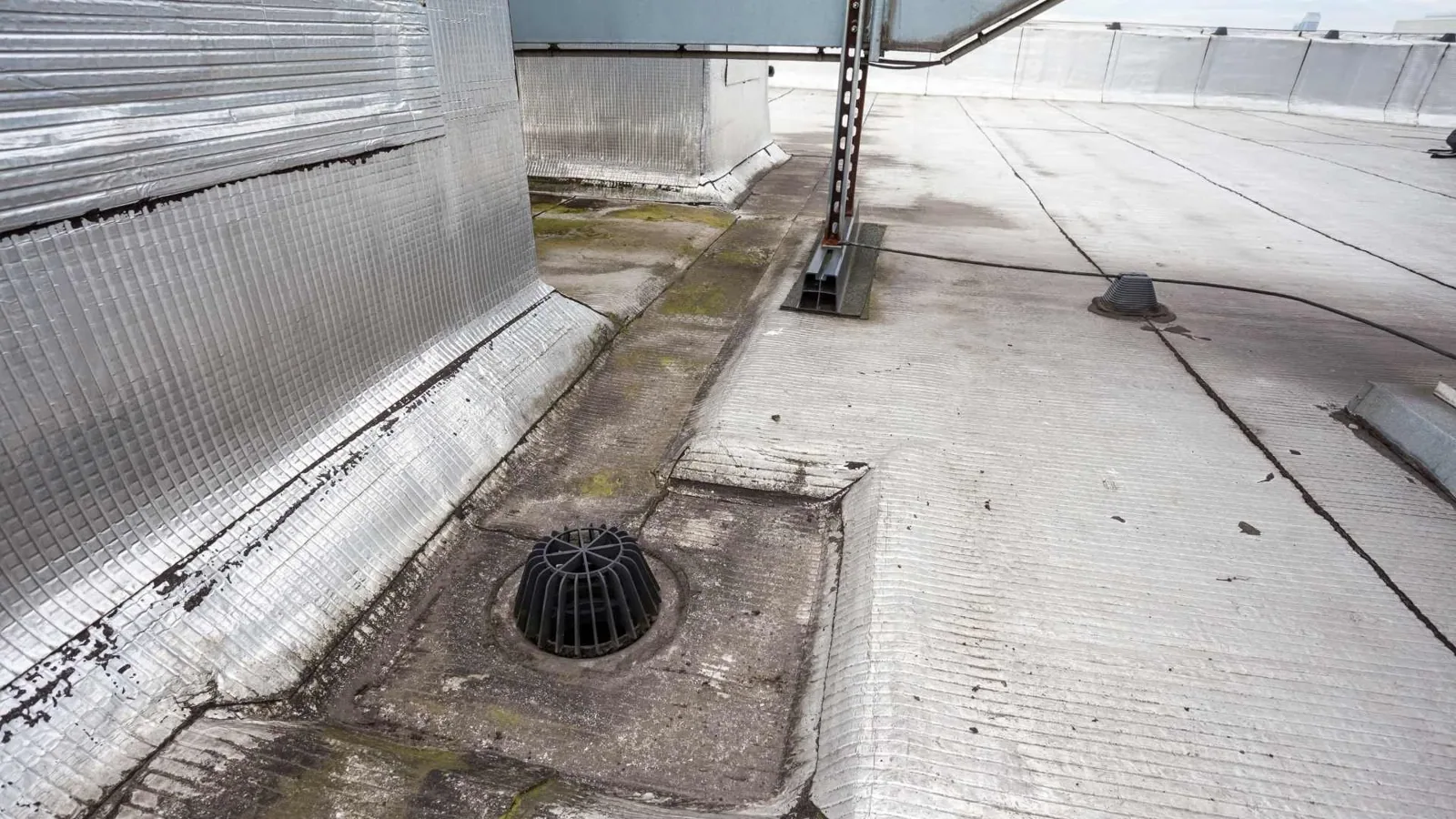
The Drain Strainer
The strainer is the first thing to clog. Leaves, grit, plastic and roofing scraps collect on it, and a half-blocked strainer slows flow enough to raise the water level around it. A full block turns an ordinary storm into a pond.
We lift every strainer, clear what is under it and run water to see how fast it leaves. A hose test on a dry day shows flow rates that rain would only show in a storm. We also look at the drain bowl and the line below. A bowl that has cracked or pulled from the membrane lets water into the deck, and a clog in the line shows up as slow flow even with a clean strainer.
Leaf guards and domes help on roofs near trees, but they need cleaning too. A dome packed with leaves is no better than a bare strainer. We note the nearest trees on the sketch and set the cleaning schedule to the season they drop leaves. Wind-blown debris from a neighboring lot or a construction site also ends up in drains, and we log where it came from.
Sumps, Crickets and Slope
Water moves to the lowest point, and the roof's slope decides where that is. A sump is the low area around a drain. A cricket is a small raised ridge, built from tapered insulation, that turns water around a unit or a wall toward the drain. When a cricket is missing or too small, water pools behind the obstruction.
We level the roof with a long straightedge and mark every low spot. Some low spots are original, where the deck was never sloped. Others are new, where a deck has deflected or insulation has compressed. The difference decides the fix.
A sump that was built too shallow is a design problem, not a maintenance problem. In that case we recommend deepening the sump or adding a drain, with tapered insulation to feed it. Cleaning alone will not end a pond that a flat deck creates.
Scuppers and Overflow Routes
A scupper is an opening through a parapet that lets water leave the roof sideways. It works only if it sits at the right height and stays clear. A scupper set too high leaves a pond behind it. One blocked by debris backs water against the wall flashing.
Many roofs also need an overflow route. If a drain clogs, water must leave by a secondary scupper before it rises above the flashing. We check that overflow openings exist, sit above the primary drains and drain freely. Our ponding water repair work starts here, because overflow is the roof's last defense.
Scupper liners and downspout heads get attention as well. A liner that has pulled from the membrane lets water into the wall, and a downspout that ends at a splash block can send water back toward the foundation. We follow the water to the ground, not just to the roof edge.
Heavy Rain Tests Every Outlet
A flash flood warning in July 2026 called for 1 to 3 inches of rain in places across northeastern Williamson County, and in May 2010 the Harpeth River reached 35.32 feet in downtown Franklin. A roof does not flood the way a river does, but a hard rain tests every drain at once. Roofs that drain well pass quietly; roofs that do not show it within the hour. Water that is still standing a day after rain stops points to a flow problem, since a healthy drain empties its sump in a matter of hours.
After a heavy rain we look at the roof while the evidence is fresh: where water stood, how long and what debris moved. That record guides the correction, and it goes into the file with the drain count. A roof condition report carries the photographs, the levels and the recommended order of work.
Correcting a Ponding Roof
Fixes range from a cleaning to a rebuild. Cleaning ends a clog. A new drain at the low point ends a pond that no strainer cleaning can fix. Tapered insulation gives water a slope where the deck is flat. A cricket turns water around a curb. Each one has a cost and a time, and the report lists them in order. A cleaning takes a morning, a new drain takes a day or two and tapered insulation is part of a planned roof section. The property manager picks the pace. Work that stops active water entry goes first, and work that improves drainage follows in the next dry window.
If the deck has sagged, the insulation under the pond is likely wet. We cut a core, test it and replace what has taken on water. A patch over wet insulation fails, and the failure comes back as a leak below. The wet layer is cut out to dry material, and the new insulation is tapered to feed the drain. A tapered insulation correction is often done with a section of new roof.
Where Drains Matter Most
Large, low-slope roofs with few drains carry the most risk. Roofs in the McEwen area include tall low-slope office buildings, and on a low-slope roof one blocked drain can affect a wide area. Along Carothers Parkway and across Cool Springs, a drain count and a map are part of the file.
Downtown Franklin is a historic district of 16 blocks on the National Register. Where a masonry building there has a parapet and scuppers, we check the through-wall flashing at each opening. Our preventive maintenance visits clear drains twice a year.
Commercial Roofing Questions
How often should roof drains be cleaned?
Twice a year at minimum, in spring and after the leaves fall. Roofs near trees or with heavy foot traffic need more.
What does a ring on the membrane mean?
It marks where water stood. A thin ring over a sound roof is a drainage matter. A ring over a soft spot is a moisture matter.
Can ponding be fixed without a new roof?
Often. A cleaning, a new drain or tapered insulation can end it. A sagging deck or wet insulation needs a larger repair.
Is an overflow scupper required?
Many roofs need one so water has a way out if a drain clogs. The need depends on the roof and the local code. We check what exists and what is missing.
Do drains need a permit to add?
An added drain changes the roof plumbing and may need local review, so the permit rules are confirmed before the scope is set.
What should I send to start?
The plan, the roof's age and any leaks you know of are enough. The roof walk traces the water from the ring back to its cause, and a brief summary follows.