National Guard Armory Roofing near Franklin, TN
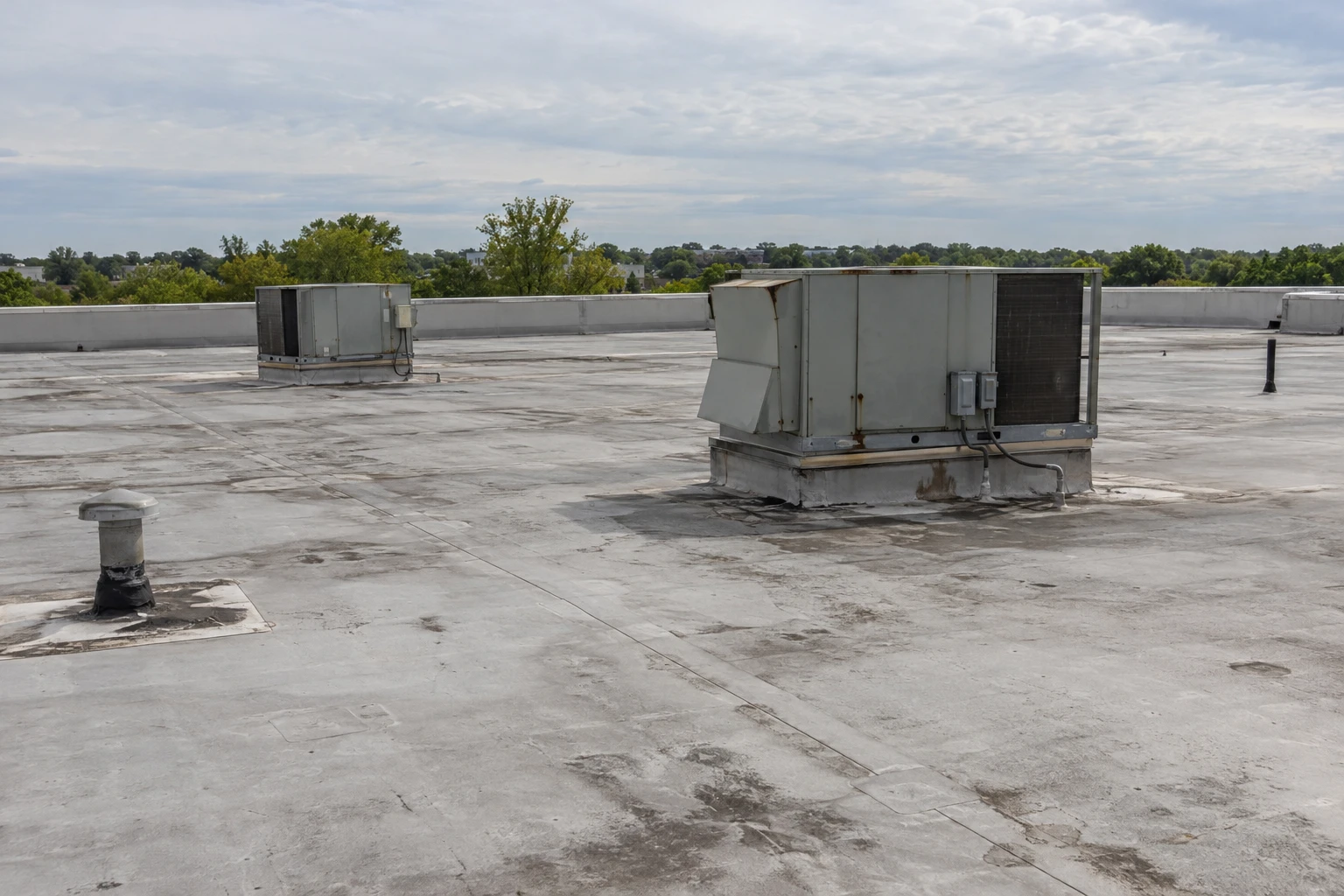
A damp stain on the drill hall ceiling, found at the start of a weekend drill, is the first sign, and it creates a deadline: the building has to be usable by the next muster. The stain marks where the water landed. The task is to follow the water up through the ceiling cavity, the insulation and the roof deck to its entry, then plan the repair around the unit's calendar. Armories and readiness centers near Franklin, TN combine a large open hall, vehicle bays and administrative wings under several roofs. Each has its own details, and each is used on a schedule that the roof crew has to respect.
The drill hall and its long span
A drill hall is a wide, clear space, so its roof spans a long distance with few supports. That roof moves with heat and cold across its whole length. In July the average high in Franklin sits near 91 F, and the record range runs from 108 F down to minus 22 F, a span the long roof feels at every panel end. Panels, seams and flashing at the ends feel that range every season.
We check the laps and end closures for open sealant, the fasteners for backing out and the gutters for sag. On a membrane roof we probe the seams, look at the drains and check the walls where a low roof meets the high hall. Each finding is photographed and marked on a roof plan.
Storm lines add to the span's load. Brentwood lies in Dixie Alley, and the August 2023 EF0 that crossed Franklin carried estimated winds near 75 mph. Large, light roofs over open halls are sensitive to uplift, so edges, corners and ridge caps get a check after every severe storm.
Vehicle bays and doors
Vehicle bays have tall doors, exhaust systems and heavy equipment, and each affects the roof. The flashing over each door header has to turn water away from the opening. Exhaust stacks and vents are penetrations that need boots or curbs. Equipment on the roof, such as heaters and fans, adds more.
Wind loads the roof when a large door is open, so the edge above the door takes force from below. After a storm we check the header flashing, the roof edge and the trim. A lifted edge here is a small repair if found early, and a larger one if the next gust takes the membrane.
Heating and ventilation equipment in a bay creates moisture of its own. Vehicles that come in wet or cold drip and steam, and the humid air rises to the roof deck. A drip in a bay may be condensation and not a leak, and the trail records the timing and the readings so the fix matches the cause.
Where the water stopped
Rain totals about 54 inches a year in Franklin, and a flat roof sheds it through drains and scuppers. A clogged strainer keeps a pond on the roof, and the pond finds any seam stiffened by heat. The trace starts at the interior stain and moves out to drains, penetrations, seams and wall joints.
Moisture scanning finds the wet layer, and cores verify what it shows. The written trail ties the room to the opening and the path between them, and it tells the unit's facilities contact whether a local repair will hold or whether the wet area is wide enough to need a larger scope. A moisture survey across the full roof shows where else water has gone.
Gutters and downspouts on a long building carry a great deal of water through a few outlets. A clogged downspout can spill onto a vehicle apron or a door track, so we clear them, check brackets and photograph the outlets in the same visit.
Access, escorts and drill schedules
Work on military property follows base access rules. Visitors are screened, badges are issued after checks, escorts may be required and material deliveries may be inspected at the gate. Roofing on these sites is commonly specified to the Unified Facilities Criteria for roofing, which set design and installation requirements. We read the specification for each project and plan the lead time for badges and deliveries.
Drill weekends and training cycles set the work calendar. Noisy tasks move to weekdays, and the hall is covered and cleared before a muster. We build a schedule with the facility manager that shows which days are available and which are blacked out. The method we use is a documented one, with every finding tied to a photograph, a test or a signed inspection.
Guard facilities around Nashville and Smyrna
Joint Base Berry Field sits roughly 20 miles northeast of Franklin at Nashville International Airport. Its tenants include the Tennessee Air National Guard's 118th Wing and an Army National Guard air cavalry squadron. About 1,500 personnel are assigned to the headquarters, the Air National Guard and the 118th Wing. The Volunteer Training Site-Smyrna and Combined Support Maintenance Shop #1 are listed in Smyrna under Joint Force Headquarters-Tennessee, Army Element.
Those sites sit in the Nashville airport area and Smyrna. Readiness buildings near them share the same roofing questions: long-span halls, maintenance shops, and strict access rules. A hangar roof and an armory roof need the same trace, applied to different buildings.
Records for the facility manager
Public facilities run on documents, so the roof file is built to travel. It holds the roof plan with every drain, curb and penetration marked, a dated photo set, moisture readings, the condition rating for each roof section and a list of repairs with dates and materials. When funding decisions come around, the manager can attach the file as it stands.
Close-out adds the warranty papers, the as-built plan and the test results. For work done under a specification, the inspection records follow the checklist the specification gives, with hold points signed by the government representative. The file then becomes the baseline for the next inspection, and each later entry shows what changed.
Repair, retrofit or replace
One failed spot on a sound roof is a repair. Many failed laps, corrosion or wet insulation may call for a metal roof retrofit or a replacement. We lay out the options with the scan, the cores and the repair count, and we list the cost drivers: roof area, height, access, schedule limits and the condition of the structure.
Public funding timelines matter. A rated inspection gives the facility manager a document to attach to a request, with the findings, the options and the risks of waiting. The same file works for government buildings and VA medical center roofs, so an agency with several kinds of building can compare them. Where base rules apply, badging and escorts are scheduled first, as on any military installation roofing job.
Commercial Roofing Questions
Can roof work happen during drill weekends?
Noisy work is scheduled for weekdays and the hall is cleared before a muster. We agree on dates with the facility manager.
What are the Unified Facilities Criteria?
They are federal design and construction criteria for military facilities, including roofing. The project specification names the sections that apply.
How long does base access take?
Badging and vehicle approval can take days or weeks. We put it first on the schedule.
What if the drill hall leaks before an event?
Phone as soon as it shows. The area is dried in, the floor protected and the permanent repair planned for a free weekend.
How often does an armory roof need a walk?
Every spring and autumn, plus once after severe storms, with the rated baseline showing which areas need more.